GALLERUM / TECHNICAL OVERVIEW
A gallery.
Several connected systems.
The engineering behind the exhibition: venue-independent media, a browser authoring tool, shared rooms and managed archive delivery.
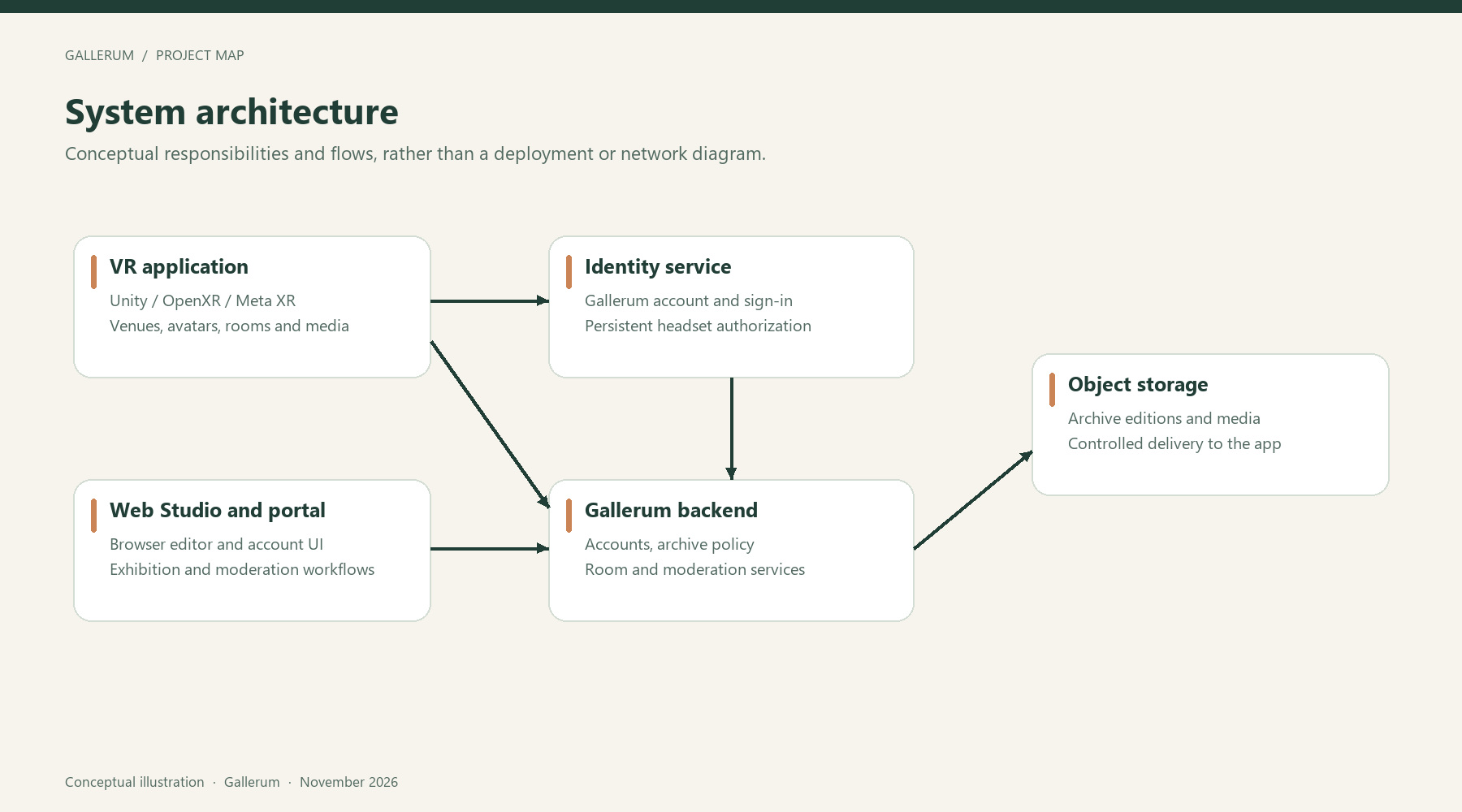
The application
and its services.
The Quest app handles navigation, presentation, avatars, media and local archives. Studio provides the browser workspace for preparing exhibitions; the portal handles account-facing and administrative workflows.
Gallerum’s backend manages archive identities, editions, access decisions, reports and shared-room coordination. Keycloak supplies identity services, while Storj object storage distributes archive content.
The service components run on a dedicated Gallerum VPS behind Caddy HTTPS. This deployment moved away from the earlier shared OpenClaw VPS; the public project website is hosted separately.
One player rig.
Interchangeable venues.
Unity, the Universal Render Pipeline, OpenXR and Meta XR form the VR application. Unity Netcode for GameObjects and Unity Transport support networking. The app owns one XR rig, its input and locomotion systems; venue modules provide the environment, arrival points, artwork slots and spatial constraints.
Indoor Gallery, Forest Park, Urban Alley and Backrooms use that common contract. A venue can change without replacing the player rig or rebuilding the collection. In shared rooms, venue changes follow host and room coordination.
The active layout has 84 artwork positions: four in the hub and four collections of 20. The archive’s layout marker is validated by the app, and unfilled positions remain empty.
Preparing media
in the browser.
Studio uses React, TypeScript and Vite, local browser storage and web workers. Creators assign media to the layout and add artwork details, artist context and optional links. CSV import helps with collections whose metadata already exists elsewhere.
Image previews use JPEG; full-resolution image data can use ASTC with mip levels. Videos use MP4 media and a JPEG poster, with dimensions and rotation recorded. Playback compatibility depends on the actual codec, file and headset.
Large media requires bounded-memory processing and recovery from interrupted or failed browser storage. A recorded owner-created archive was downloaded, opened and reopened on Quest; broader media, browser and lifecycle testing continues.
An archive identity.
Separate editions and access.
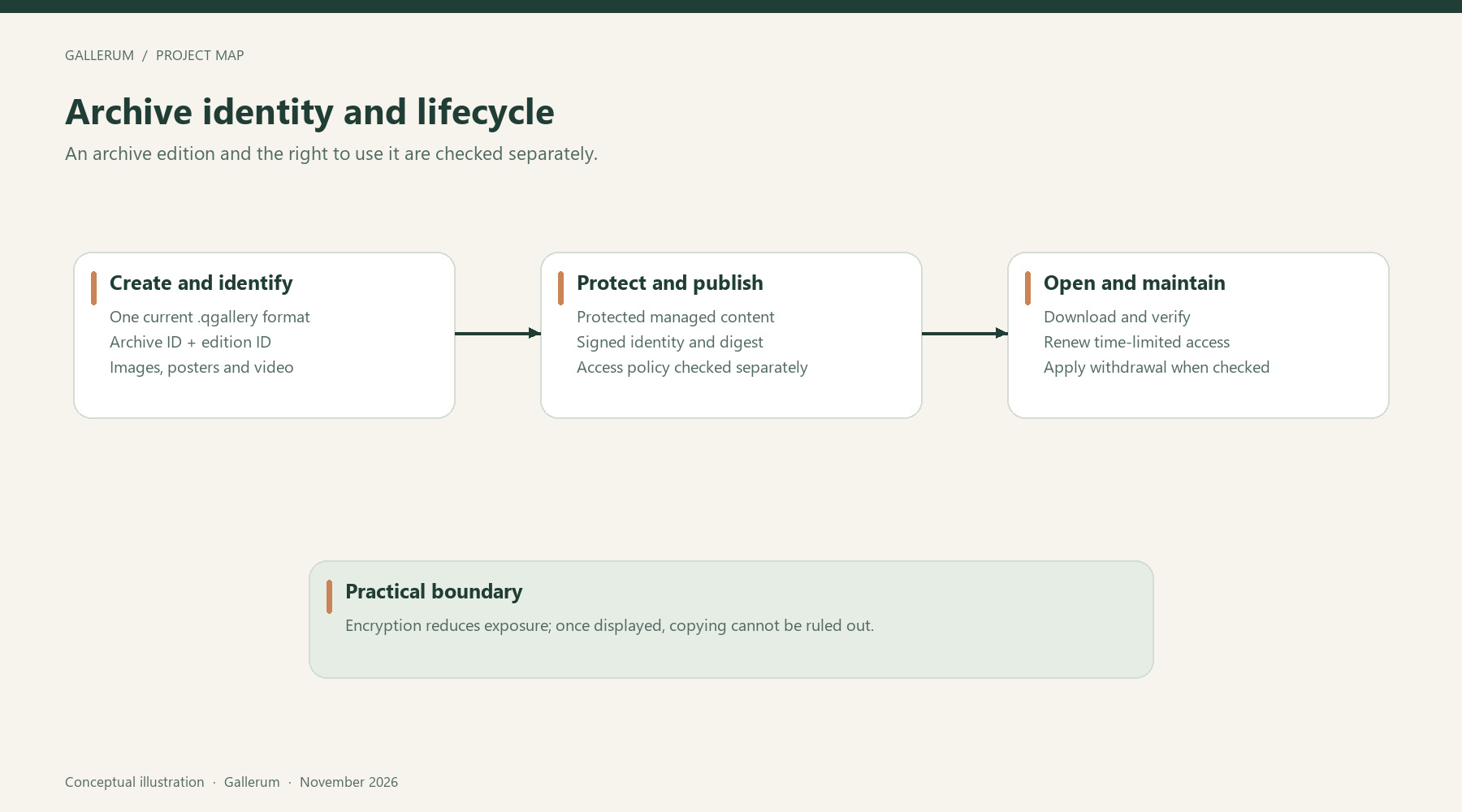
The current .qgallery format 5 is a ZIP/ZIP64 container with public metadata and an inner manifest. A server-issued archive identity persists across immutable editions. The signed outer manifest binds an edition to its archive length and SHA-256 digest.
This separates four responsibilities: what the collection is, which edition is being delivered, whether its bytes are intact and who may open it. An update is verified and adopted before the previous working copy is discarded.
Protection with
defined boundaries.
Managed protected entries use the QENC1 envelope: AES-256-CBC encryption with a fresh IV and HMAC-SHA256 authentication, using separate key material. The authentication tag is checked before plaintext is used, and each managed edition receives a fresh content key.
The backend wraps content keys at rest using AES-256-GCM and controls their release according to access policy. Official public demos can use open content while retaining signed identity and withdrawal handling.
This is managed protection: the service operator is part of the trust model. It is not end-to-end encryption against the operator, and it cannot prevent an authorised viewer from capturing displayed content.
Sharing, offline access
and withdrawal.
Signed grants bind an archive edition to a delivery and installation. Managed offline access lasts at most 24 hours after an approved check, or less if the grant expires sooner. A failed connection is not a withdrawal; once the permitted interval ends, the content stays locked until access can be renewed.
A guest is not automatically allowed to redistribute an archive. When the app successfully receives a withdrawal decision, it removes the relevant managed material and reports an installation-specific cleanup receipt.
An offline headset cannot be made to delete content immediately. The receipt records what the application reports doing; it is not proof that no external copy exists.
Accounts, shared rooms
and moderation.
Gallerum accounts are independent of a headset vendor’s user ID. A browser-based short-code flow links the headset, while persistent refresh credentials use Android Keystore-backed encryption in app-private storage.
Avatars, usernames, friends, visitor maps and host controls support shared visits. Public rooms are designed as persistent destinations with an administrator-selected gallery and default venue, including when that administrator is offline.
Reports can concern a person or an archive. User restrictions and archive withdrawals are separate decisions: the restriction model preserves solo use, access to the user’s own data, recall and support while limiting shared participation, new shares and publication. These paths have staged implementation and targeted tests; full physical end-to-end testing remains part of the work.
Performance is part
of the experience.
The environments combine simplified geometry, baked lighting, texture formats suited to the headset, visibility control and selective UI updates. Forest Park prompted focused Quest 2 optimisation; real-device feedback guides the balance between detail and comfortable performance.
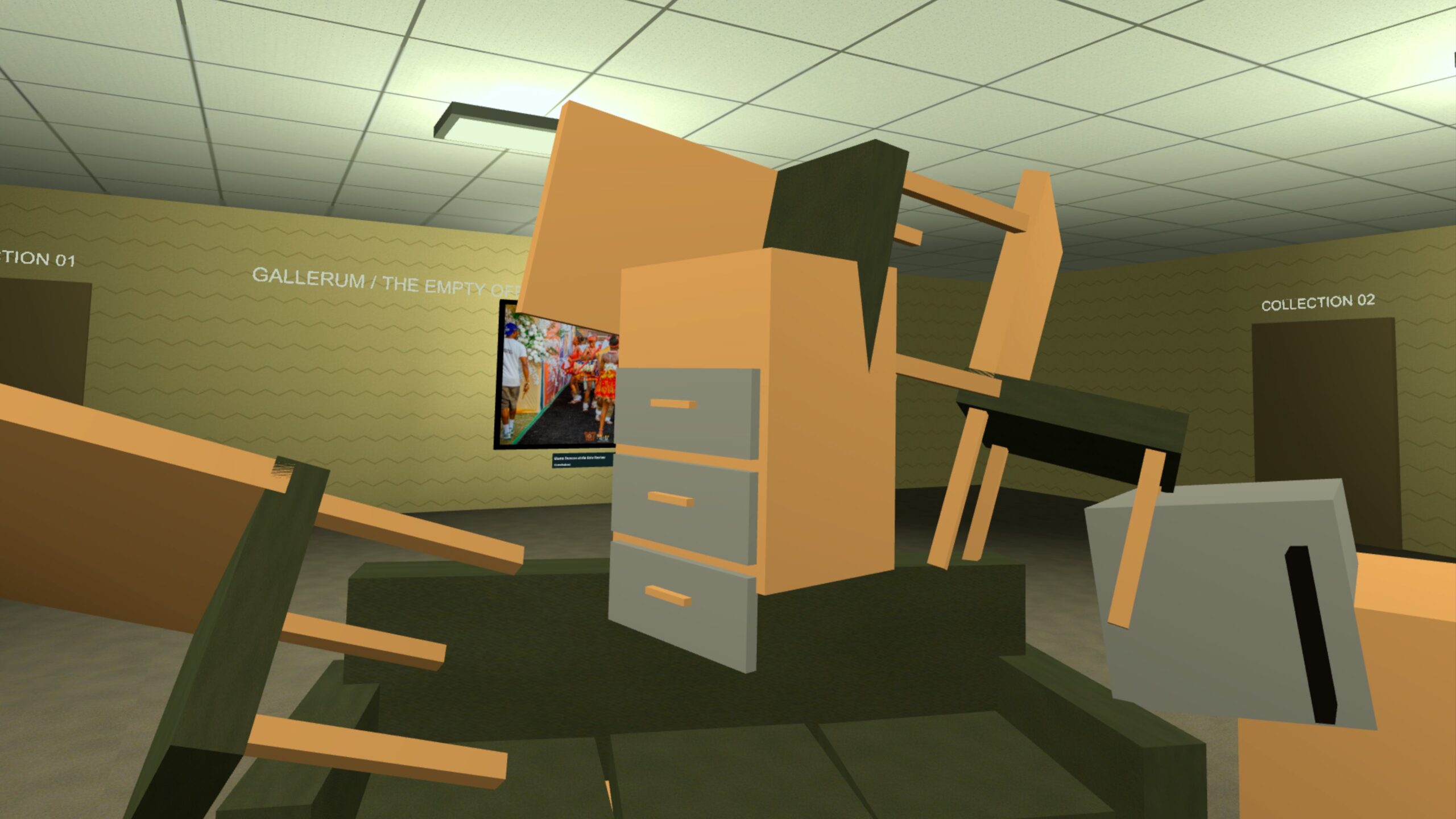
Backrooms required repairs to overlapping wall and ceiling geometry, its own visibility data and refinements to wall markings. Menus, pointer interaction, controller tracking and seated posture across venue changes also require testing in the headset. Device-specific tracking and posture findings remain under investigation.
Verification
and release status.
The project uses Git checkpoints, a retained stable fallback and documented service release and rollback procedures. Validation combines Unity/editor checks, web and backend tests, APK version and signing checks, Meta channel verification and physical headset testing. A successful build is only one part of acceptance.
Recorded on 30 October 2026: version 0.14.0-alpha.67, build 167, was delivered to a private Meta ALPHA channel with all four venues. Meta compatibility checks were still running when recorded. Backrooms wall repairs and markings had positive Quest 3 feedback; performance of this candidate on Quest 2 remained pending.
Studio, account and archive workflows have passed selected real scenarios. Remaining work includes broader offline and recovery tests, moderation and withdrawal walkthroughs, browser/media compatibility and consistent interaction across devices. This is a development snapshot, not a completed public release or an independent security audit.
Project documentation
and related work.
Source and engineering documentation are held in the private project repository; access is required.
Gallerum Studio · Privacy statement · Discord community
AI in practice describes the wider development approach behind this and my other projects.
IDEAS & PERSPECTIVES
Good ideas grow
through conversation.
I enjoy exchanging perspectives on people, technology and the things we learn by putting ideas into practice. If something here sparked your curiosity, let’s connect.