PERSONAL SOFTWARE PROJECT · IN DEVELOPMENT
Local AI
Workbench.
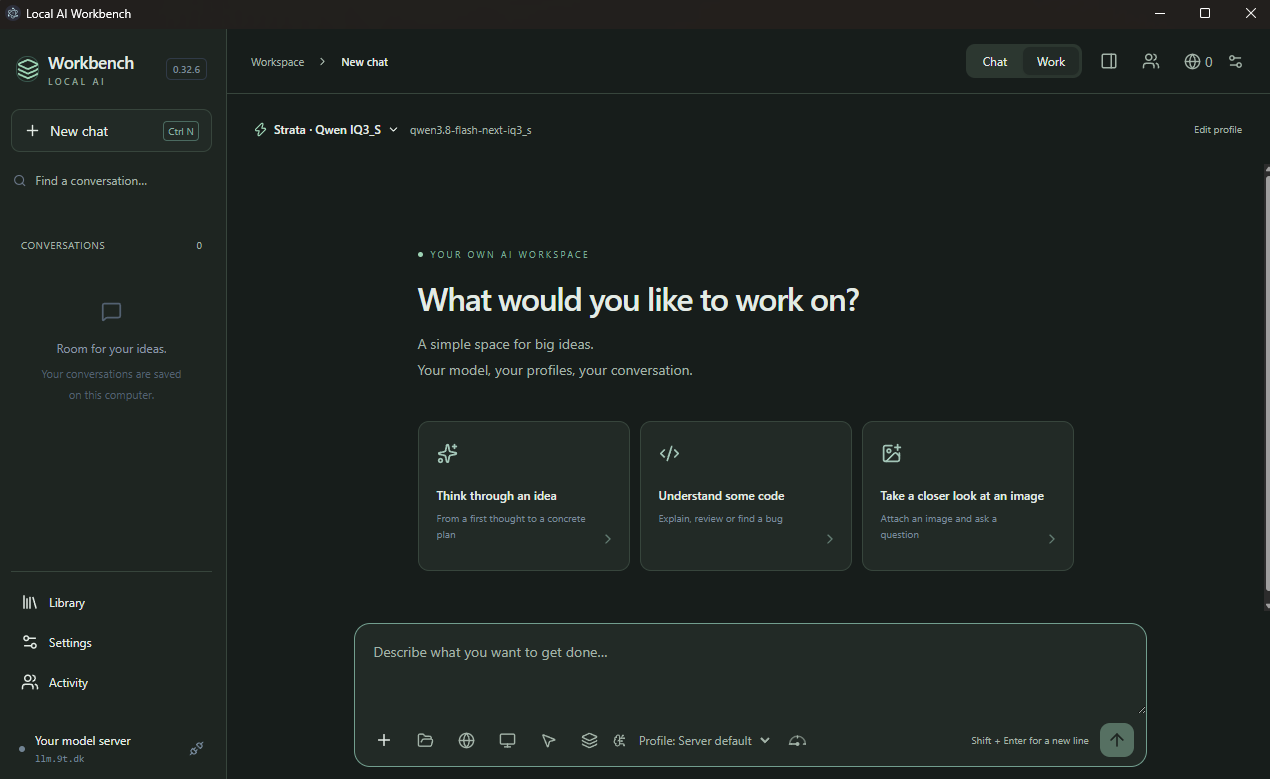
A desktop workspace for local models, connected tools and tasks that need more than a single answer.
I am developing the application that surrounds the model: how it receives context, uses tools, keeps track of work and presents the result. The project grew from wanting more control over that whole process.
- Core
- Local language & vision models
- Connection
- Strata / OpenAI-compatible API
- Status
- Working application, ongoing development
THE APPLICATION
More than
a chat window.
The workbench brings model profiles, conversations, image input and connected tools into one desktop application.
Its development includes file operations, web search, browser and computer interaction, as well as extensions and reusable skills. MCP connections provide another way to make tools available. These capabilities have different requirements and need testing with the model being used.
Local models are the core of my setup. Connected search and other integrations can still use external services; choosing where the model runs is only one part of deciding how the whole workflow operates.
THE HARDER PART
Knowing when
the work is done.
A model can stop answering while there is still work left. It can also describe an action without having performed it.
I encountered this directly with image-processing tasks. That led to saved work queues, explicit progress, stop-and-resume behaviour and checks against recorded tool results. The application needs to distinguish a finished response from a completed task.
Error handling, retries and clear pauses are part of the same work. The aim is to make unfinished or failed work visible and recoverable, rather than leave the user guessing.
TESTING & ITERATION
Measuring the task,
not just the model.
I compare changes using repeatable tasks and the same model settings, looking at completion, errors, output quality and elapsed time.
Automated checks are combined with live runs against the local model server. Batch image work has also exposed practical questions about context, original image resolution, memory and the time spent waiting for model responses.
The result is a working application that continues to evolve. Reliability depends on both the software and the model, so improvements are tested against concrete tasks rather than treated as a general guarantee.
CONTINUE EXPLORING
Connected work.
Different applications.
PhotoScanner
A focused application for one demanding image workflow.
AI in practice
The wider collection of AI projects and learning.
IDEAS & PERSPECTIVES
Good ideas grow
through conversation.
I enjoy exchanging perspectives on people, technology and the things we learn by putting ideas into practice. If something here sparked your curiosity, let’s connect.